
Exposé: How Pit Bull Advocacy Uses Manipulation, Not Facts ☑️
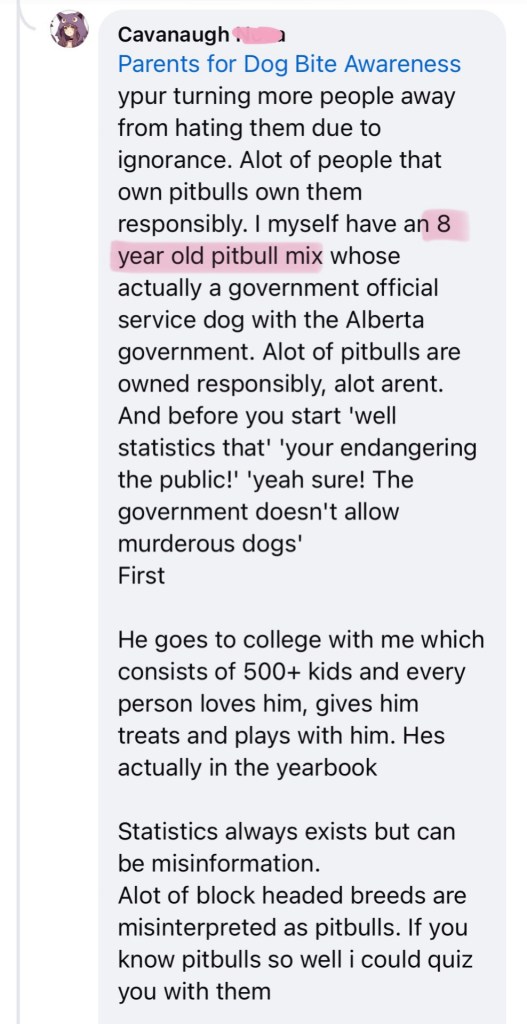
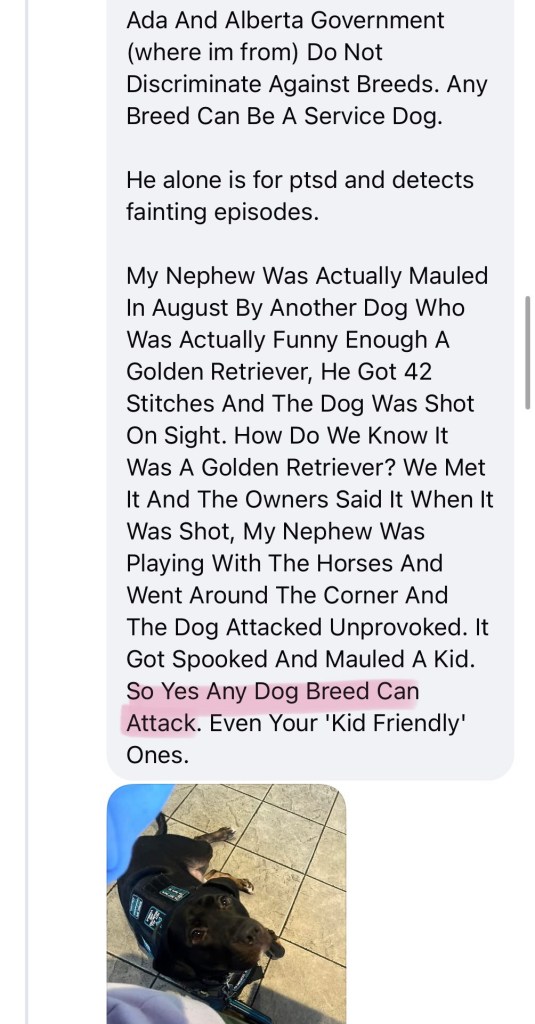

Cavanaugh’s response is a textbook example of how pit bull advocacy often mirrors abusive communication patterns. When faced with clear statistics and logic, instead of engaging honestly, advocates deploy manipulation tactics to deflect from the truth. Let’s break it down:
1. Deflection Through Anecdotes
“I have an 8 year old pitbull mix who is a government service dog…he goes to college with me…everyone loves him.”
This is classic “not all” deflection. Instead of addressing the population level risk, the advocate pulls out a personal story to tug on emotions. It’s the same as saying “I smoked my whole life and never got cancer” and it’s irrelevant to the data showing risk across a population.
2. Appeal to Authority (False Credibility)
“…actually a government official service dog with the Alberta government…”
Bringing in “government” and “service dog” status is meant to project authority and credibility. But we know service dog status is not proof of safety as even “certified” dogs have attacked. It’s a psychological strategy to silence criticism, not evidence that pit bulls are low risk.
3. Misdirection With a Golden Retriever Attack
“…my nephew was mauled…by a Golden Retriever…so yes any dog can attack.”
This is whataboutism. Instead of addressing why pit bulls commit the majority of fatal and disfiguring attacks, the advocate points to an outlier incident. It’s like saying, “Cars don’t cause more deaths than bicycles, because once I saw a bicycle accident.” It muddies the waters without actually disproving the core issue: pit bull type dogs are disproportionately represented in severe maulings and fatalities.
4. Gaslighting and Accusations of “Hate”
“…you’re turning people away…you’re just anti pitbull…”
Rather than debating evidence, the advocate shifts the focus to tone policing and attacking the messenger. This is a psychological ploy to paint factual discussion as emotional hatred, which discourages people from asking questions or seeking the truth. It mirrors abuse dynamics in disordered families that teach members of you criticize, you’re “mean” or “hateful,” so better to stay quiet.
5. Minimization of Risk
“…statistics always exist but can be misinformation…”
This is an attempt to discredit hard data with vague hand waving. By suggesting that statistics are “misinformation,” the advocate undermines reality itself. It’s a manipulation strategy: when the facts don’t suit them, they simply claim the facts don’t exist.
The Bigger Picture
This pattern isn’t about one person, it’s a repeated advocacy script that keeps dangerous dogs embedded in communities. It uses the same techniques abusers use on their victims:
• Deflect blame (it’s owners, not the dogs)
• Shift focus (talk about Golden Retrievers instead)
• Attack the critic (accuse them of bias or hate)
• Invalidate reality (statistics are “misinformation”)
Just like in toxic relationships, the goal is control: controlling the narrative, silencing dissent, and normalizing harm.
Real awareness means cutting through manipulation and naming things for what they are. Facts aren’t hate. Statistics aren’t bias. Protecting families isn’t prejudice.
-JL



 Parents for Dog Bite Awareness
Leave a comment