We frequently receive comments and messages from pitbull advocates expressing confusion, shock, or pure naïveté about rescue marketing. They often say they don’t see anything wrong, or can’t find any issue.
So let’s use Donny’s ad to unpack some basic marketing and psychology tactics. I’m choosing Donny to be fair because he isn’t the worst we’ve seen.
-JL #dba
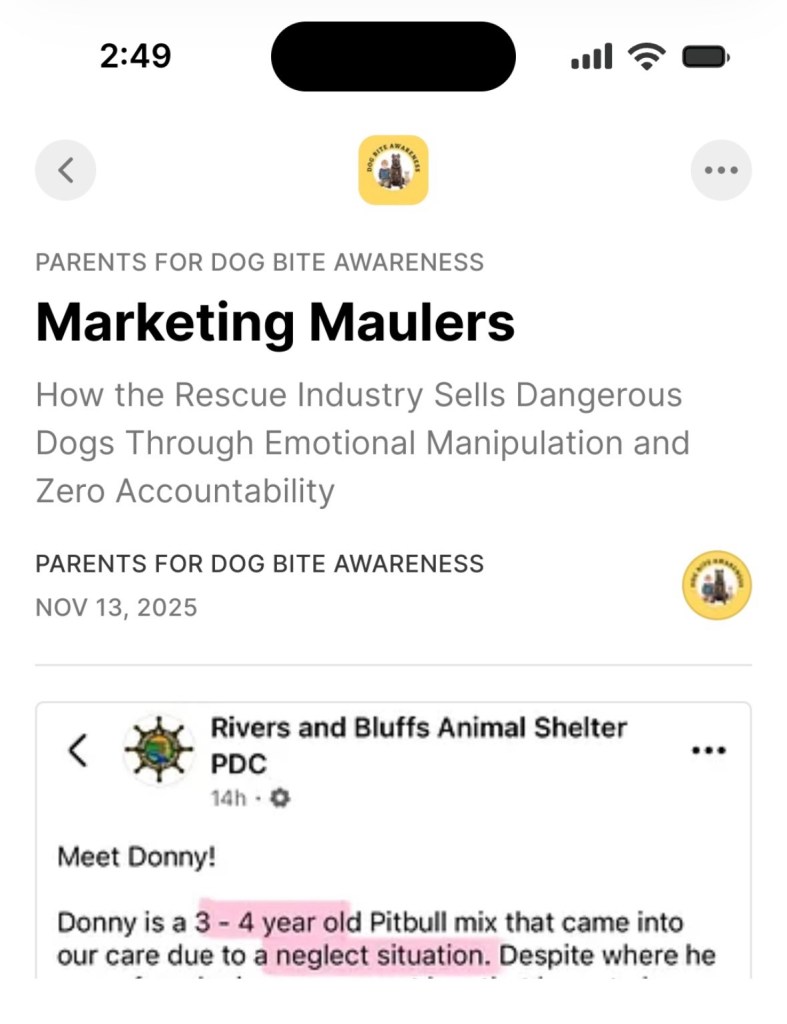
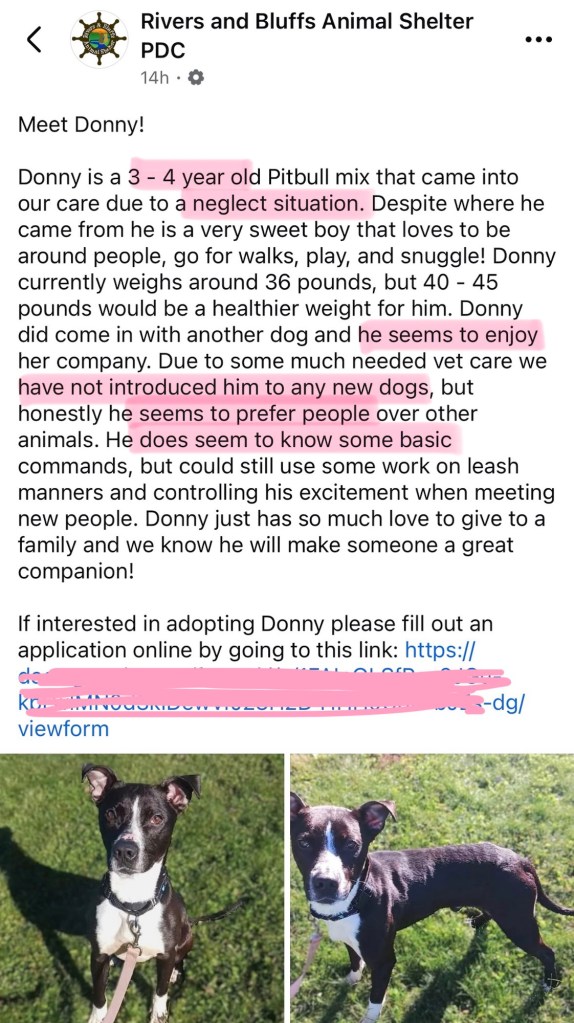
This ad reads like a sentimental Hallmark pitch for what is, in reality, an adult male fighting breed mix with incomplete temperament data, a neglect history, and behavioral red flags.
Let’s dismantle it step by step 👇
1. Emotional Framing / Pity Appeal
“Came into our care due to a neglect situation… Despite where he came from he is a very sweet boy…”
This language weaponizes empathy. By invoking neglect, the ad immediately disarms the reader’s critical thinking and transfers focus from safety to “rescue redemption.” It primes people, especially empathetic or neurodivergent people, to feel responsible for “saving” the dog, not evaluating risk.
🔹 Fallacy: Appeal to emotion
🔹 Reality: Abuse history correlates with increased risk, not innocence.
2. Minimization Through Vague Euphemisms
“Seems to enjoy her company,” “has so much love to give,” “could still use some work…”
This softens concerning behavioral gaps. The ad uses what’s called indefinite qualifiers (“seems,” “some,” “could”) that imply normal dog behavior while quietly admitting no testing with new dogs and poor impulse control around people.
🔹 Fallacy: Euphemistic rebranding
🔹 Reality: “Controlling excitement” often means high arousal, jumping, or mouthiness, which are precursors to serious dog attacks.
3. False Sense of Safety
“Very sweet boy that loves to be around people…”
Common marketing move: assert the dog’s sweetness early to build trust before admitting concerning traits later.
This creates cognitive dissonance so that readers cling to the first positive claim and discount later negatives.
🔹 Fallacy: Primacy effect manipulation
🔹 Reality: No independent temperament evaluation, bite history disclosure, or containment plan is listed.
4. Incomplete Risk Disclosure
“Due to some much needed vet care we have not introduced him to any new dogs…”
This seemingly innocuous statement hides a major red flag: lack of dog to dog testing means bite potential is unknown, yet he’s being advertised publicly for adoption.
There’s also no mention of children, cats, or household requirements, meaning the rescue is not practicing basic public safety standards.
🔹 Fallacy: Omission bias
🔹 Reality: In a regulated industry, this would violate duty of care protocols.
5. Anthropomorphism & Soulmate Language
“So much love to give to a family…”
This mirrors dating marketing, not animal risk assessment. It anthropomorphizes the dog as a wounded romantic partner rather than an unpredictable animal with bite potential.
Such framing targets emotionally vulnerable adopters, especially those who crave purpose, healing, or validation through “saving” something.
🔹 Fallacy: Emotional projection
🔹 Reality: Dangerous dogs are often adopted by emotionally codependent individuals, sometimes with reduced cognitive defenses (e.g. trauma survivors, isolated elderly, neurodivergent or developmentally delayed adults).
🧠 𝗪𝗵𝗮𝘁 𝗧𝗵𝗶𝘀 𝗥𝗲𝗮𝗹𝗹𝘆 𝗠𝗲𝗮𝗻𝘀
The rescue industry operates almost entirely unregulated. There’s no federal oversight, no liability standards, no uniform bite disclosure laws, and often inadequate insurance.
This means organizations can market and distribute high risk dogs into neighborhoods, even to families with kids, without consequence.
They use:
• Emotional storytelling to override logic
• Hashtag activism to cloak liability in virtue
• Linguistic laundering (replacing “aggression” with “reactive”)
• Selective omission to dodge accountability
When a tragedy occurs, they claim:
“We had no way of knowing!”
“He was always so sweet until suddenly he wasn’t!”
And the cycle continues with a new dog, new sob story, new victim.
⚠️ 𝗪𝗵𝗼’𝘀 𝗠𝗼𝘀𝘁 𝗩𝘂𝗹𝗻𝗲𝗿𝗮𝗯𝗹𝗲
Certain demographics are specifically targeted or disproportionately susceptible to this kind of manipulation:
• Young adults seeking identity and meaning (“rescue mom/dad” status)
• People with trauma histories who interpret saving animals as redemption
• Neurodivergent or cognitively limited adults drawn to “unconditional love” narratives
• Low-income adopters misled by waived fees or emotional advertising
Tragically, they are the same people least equipped to handle or financially manage the consequences of a serious bite or fatal attack.
💬 𝗜𝗻 𝗦𝘂𝗺𝗺𝗮𝗿𝘆
This isn’t a rescue story. You’re looking at marketing spin wrapped around liability transfer.
Unvetted, underregulated organizations push out dangerous animals and rely on emotional manipulation to silence criticism.
Every euphemism hides a potential statistic.
Every “Donny” ad is another roll of the dice for a family that has no idea what risk they’re bringing home.
It’s critical to provide marketing literacy so that those who are most vulnerable to these techniques can become empowered to protect themselves and their families from predatory advertising.
#DogBiteAwareness #RescueReform #AdoptResponsibly #DogSafetyMatters #PublicSafetyFirst #PitbullMyth #RescueIndustry #EmotionalManipulation #TruthOverTragedy 🐶💔 #Parentsfordogbiteawareness
 Parents for Dog Bite Awareness
Leave a comment