Whenever a serious dog attack happens, especially one involving pit type dogs, the public conversation tends to split into two groups.
One group wants to talk about the facts, the patterns, and the very real risks that communities are facing.
The other group immediately pulls the discussion into a bizarre philosophical side alley: humans are dangerous too, children can hurt people, don’t judge breeds, love and training cure everything, nothing is genetic, and so on.
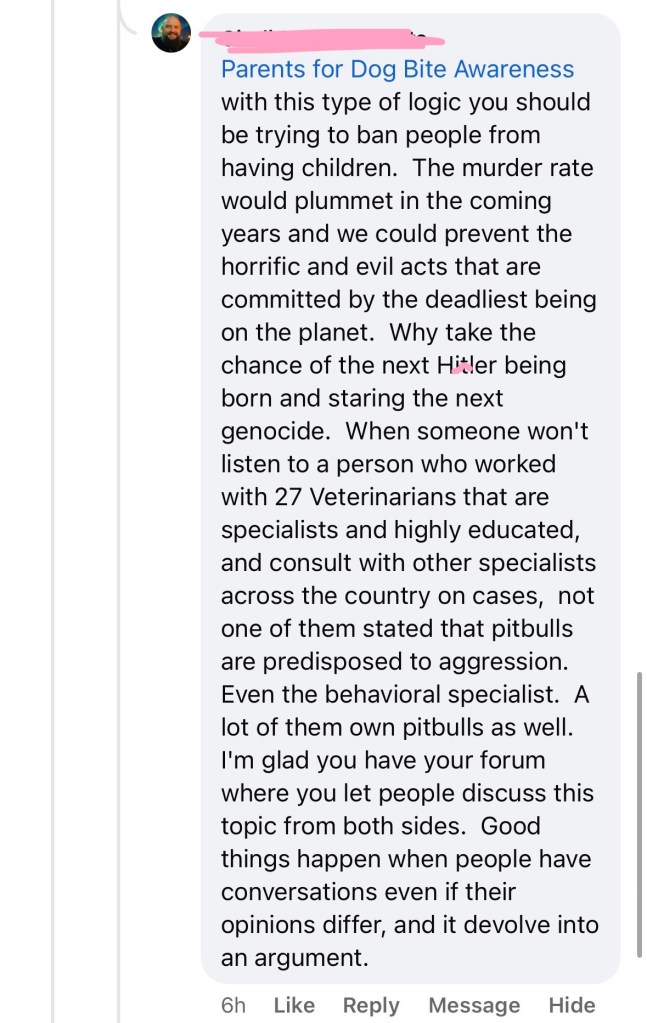
A recent comment under a news story about two pitbulls killing a smaller pet is a perfect example. Instead of addressing the dog attack, the commenter launched into a tangent about how “with your logic, we should ban children because the murder rate would plummet” and brought up Hitl&/. By the end, they insisted that they had worked with 27 veterinarians who said pitbulls are not predisposed to aggression.
This has become a predictable pattern. It is also one of the reasons the dog bite epidemic continues.
Below is a breakdown of why this type of argument is flawed, why it functions as deflection, and why it ultimately protects the very conditions that cause more attacks.
-JL #DBA
- False Analogies Shut Down Honest Risk Assessment 🤨
Comparing dog breeds to humans is not meaningful. Human children are not a selectively bred category with behavioral traits shaped over hundreds of years for fighting, gripping, or gameness.
The comparison is not just scientifically inaccurate. It is designed to derail the conversation. Once someone drags the discussion into “What about Hitl&/?” the actual issue is gone. This tactic turns a practical safety conversation into an emotional spectacle.
When people cannot engage with the facts, they shift the focus to extreme human stories so the original topic disappears.
- Unverifiable Credentials Replace Data 🤔
The commenter said they had worked with “27 veterinarians” and none believed pitbulls had genetic predispositions. This claim is impossible for readers to verify and contradicts the existing peer reviewed veterinary and medical literature, which documents:
- disproportionate severe injury rates
- higher fatality rates
- sustained biting (hold and shake behavior)
- difficulty stopping attacks
- higher rates of redirect aggression
Citing unnamed “specialists” as if this outweighs decades of documented case series, hospital data, and animal behavior research is not meaningful evidence. It is an appeal to authority in its vaguest form.
People fall for these claims because they are framed confidently. Confidence is not data.
- Emotional Framing Manipulates the Reader 🤡
Statements like “many specialists own pitbulls” are designed to evoke trust and comfort. They also imply that if you don’t agree, you must be ignorant, irrational, or hateful.
This is a social pressure tactic.
It steers the conversation away from the harm done to animals and people and toward social conformity and emotional reassurance.
The result is that public safety becomes secondary to the rescuer’s narrative about love and redemption.
- Faux Civility Masks the Initial Hostility
The commenter began with accusations about killing children and preventing the next Hitl&/, yet ended by praising “good conversations” and claiming to value both sides.
This tactic softens the tone to make the critic look unreasonable if they push back. It is a manipulation that allows the commenter to appear calm and diplomatic while having opened with an inflammatory and insulting comparison.
This pattern keeps reappearing in dog attack debates because it works. People feel pressured to be polite while the other side uses incivility disguised as discussion.
- This Kind of Thinking Enables the Cycle of Attacks 💔
Every time someone derails the conversation with absurd analogies, vague credentials, or emotional persuasion, the opportunity to address real safety issues is lost.
Communities cannot improve safety if they cannot even talk about risk honestly.
Families cannot make informed decisions if the moment they raise concerns, they are told it is equivalent to eugenics or child genocide.
The rescue and advocacy industry benefits from this confusion. These groups face almost no regulation and no accountability for placing high risk dogs into homes. As long as discussions remain emotional instead of factual, nothing changes.
When public conversation is dominated by magical thinking, sentimental storytelling, and false assurances from unnamed “experts,” dangerous placement practices continue untouched, and more families suffer preventable tragedies.
What We Need Instead
- clearer public understanding of breed specific behavior
- acknowledgment that genetics influence risk
- honest reporting from shelters
- accountability for placing dangerous dogs
- recognition that safety is not hatred
- policies based on data, not wishful thinking
Until we can have grounded, factual conversations about dog bite risk, the problem will keep repeating. Deflection keeps communities vulnerable. Accurate information keeps them safe.

 Parents for Dog Bite Awareness
Leave a comment