Here’s my daily #PSA that we need to unite to expose the #rescue industry, reform it, and regulate it.
When rescues lie, manipulate, and otherwise participate in trafficking violent dogs into our communities, we need to ensure the organizations are being heavily fined and all involved workers and foster volunteers face stringent criminal sentencing.
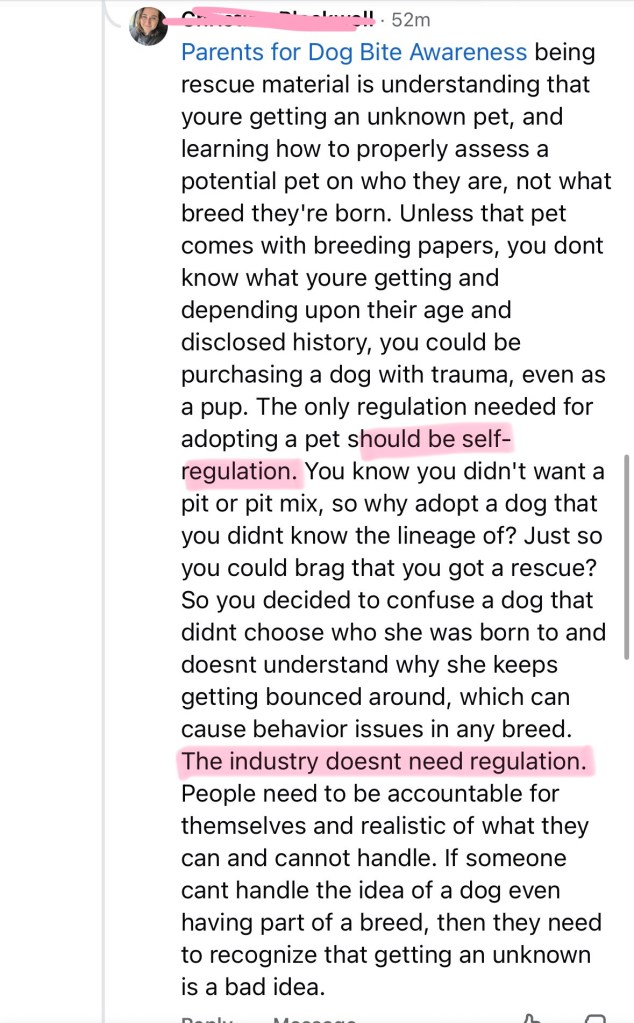
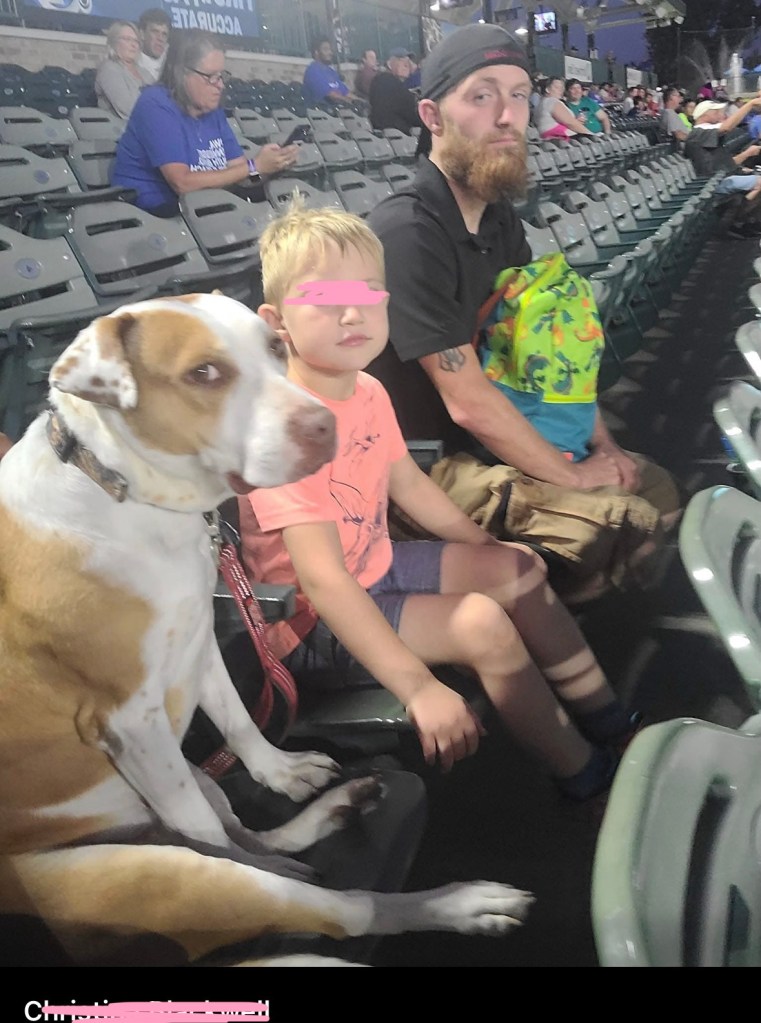
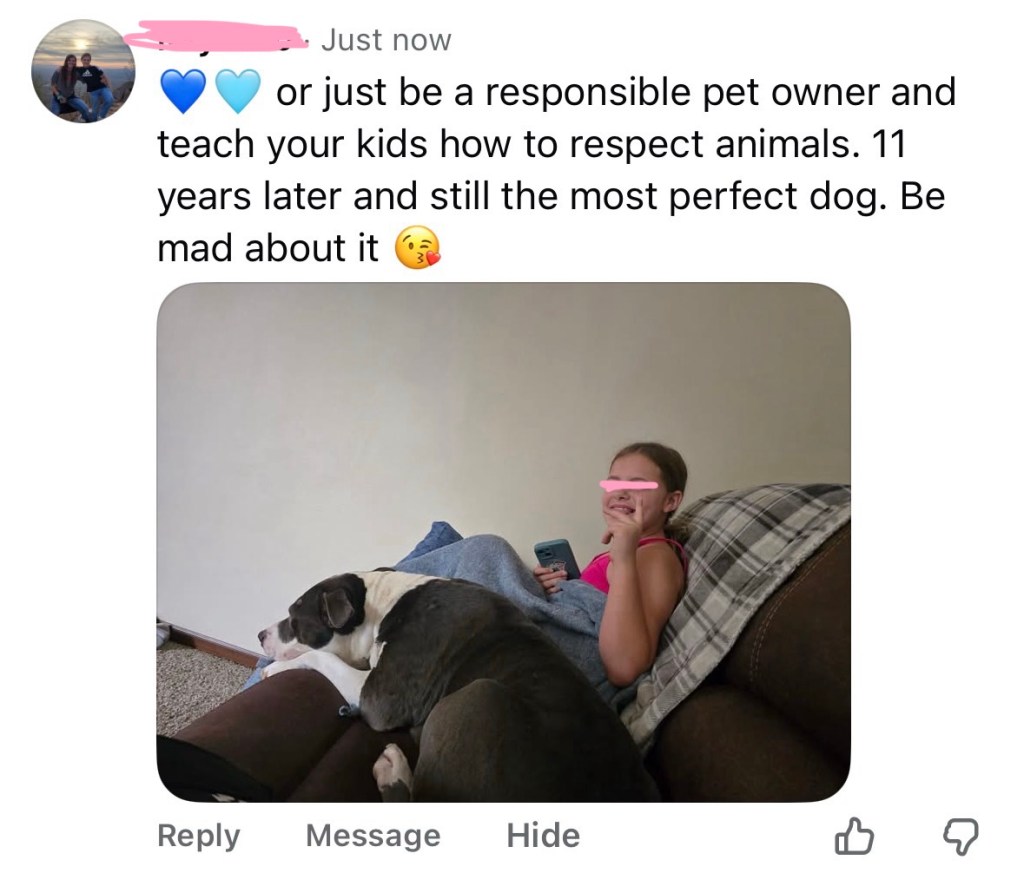
This woman, who fosters dogs and is a third party dealer for the rescue industry, provides a perfect example of how rescue culture rhetoric uses blame shifting, magical thinking, and false equivalencies to redirect responsibility away from the rescue industry and onto the adopter.
Let’s unpack her game.
-JL #dba
- “Breed doesn’t matter” is scientifically false.
The commenter claims adopters should judge “who they are, not what breed they’re born.” But breed is the single strongest predictor of behavioral tendencies, risk patterns, arousal thresholds, and bite style.
Pretending breed is irrelevant is ideological and not factual.
- They admit rescues sell unknown dogs… and then blame YOU for not knowing.
They say:
“Unless that pet comes with breeding papers, you don’t know what you’re getting.”
This is an accidental admission that rescues regularly adopt out unidentified animals with unknown lineage, which makes risk assessment nearly impossible.
Yet they blame the adopter for not knowing what the rescue itself hides or mislabels. It’s a reminder that the accepted standard in the rescue industry is a lack of informed consent and a lack of ethical assessment.
- They frame serious liability as a “self regulation” issue.
“The only regulation needed is self regulation.”
This is a classic anti regulation talking point used by industries that profit off risk (backyard breeders, rescues, and shelters).
Imagine this logic in any other context:• “The food industry doesn’t need regulation, just self regulation.” • “Firearms sales don’t need regulation, just buy responsibly.” • “Daycares don’t need regulation, parents should self assess.”
It’s absurd. High risk industries require safeguards precisely because self regulation fails.
- They weaponize guilt by implying adopters “confuse” the dog emotionally.
“So you decided to confuse a dog who doesn’t understand why she keeps getting bounced around.”
This is emotional manipulation.
Rescue organizations, not adopters, create the revolving door environment by:• mislabeling dangerous dogs • minimizing risk • refusing behavioral euthanasia • prioritizing “live release numbers” over public safety
The adopter is not the party responsible for the dog’s instability. Just as a customer is not the party responsible for safe food manufacturing or vehicles with non defective airbags.
- They imply trauma is random and breed agnostic, which is false.
“Trauma can cause behavior issues in any breed.”
Trauma may exacerbate issues in any dog, but only certain breeds escalate to catastrophic aggression, especially the sustained, gripping, dismembering style of attack unique to fighting breeds.
This ignores crucial distinctions:
• A traumatized collie may snap and retreat.
• A traumatized pit bull may maul, dismember, and not stop.
Risk is not symmetrical across breeds.
- They set up a trap: “If you don’t want a pit bull, you shouldn’t rescue at all.”
This argument is extremely common in pit advocacy spaces.
They claim:
• shelters are full of pit mixes
• breed labels are “unknowable”
• adopters who want breed transparency are “superficial”
But the real goal is to force pit bull acquisition by removing choice.
If you don’t want a pit bull, the message is:
“You’re the problem and rescue isn’t for you.” This is a fascinating tactic against the broad, heavily promoted concept that (all people should) adopt, don’t shop.
- They use the “you only want a rescue for bragging rights” smear.
This is designed to shut down legitimate concerns by attacking the adopter’s character. It’s a manipulation tactic. More importantly, it reveals their inner guilt as disordered people tend to project their internal agendas onto their targets.
- They deny the rescue industry’s responsibility for screening, labeling, and safety.
The comment insists:
“People need to be accountable for themselves.”
But she never acknowledges the industry’s responsibilities:
• Safe temperament testing
• Honest breed identification
• Medical and behavioral transparency
• Liability disclosure
• Public safety
• Ethical euthanasia when necessary
A consumer cannot be accountable for information they are intentionally denied.
- They contradict themselves.
They claim:
• breed doesn’t matter
• unknown lineage doesn’t matter
• trauma explains behavior
• but adopters must “assess” anyway
You cannot assess a dog if the rescue hides its breed, history, and true risk profile. And if breed doesn’t matter and trauma can be fixed by adopting to a new owner, then the buyer can’t be wrong. See the looping logic?
- The entire message shifts systemic failure onto the adopters.
This is the central manipulation:
Rescue practices create the risk, but adopters are blamed for experiencing it.
Victims are reframed as perpetrators.
The industry reframes itself as blameless.
And the industry becomes a holy martyr that cannot be criticized.
 Parents for Dog Bite Awareness
Leave a comment