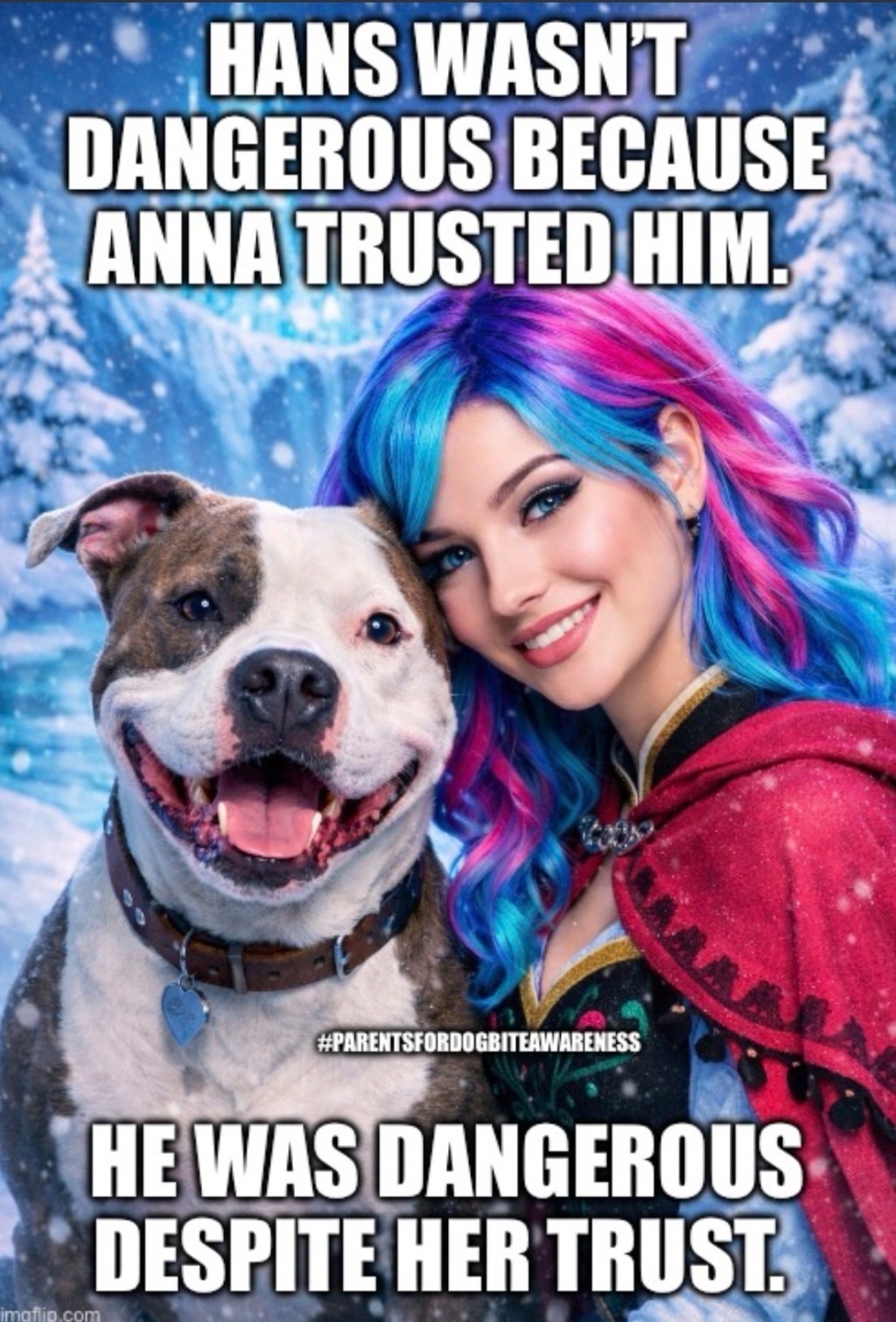
“Did you know pitbulls pass the ATTS test 80% of the time?”
Bloodsport enthusiasts frequently refer to how friendly, charming, and cuddly pitbulls are as if this negates their innate risks.
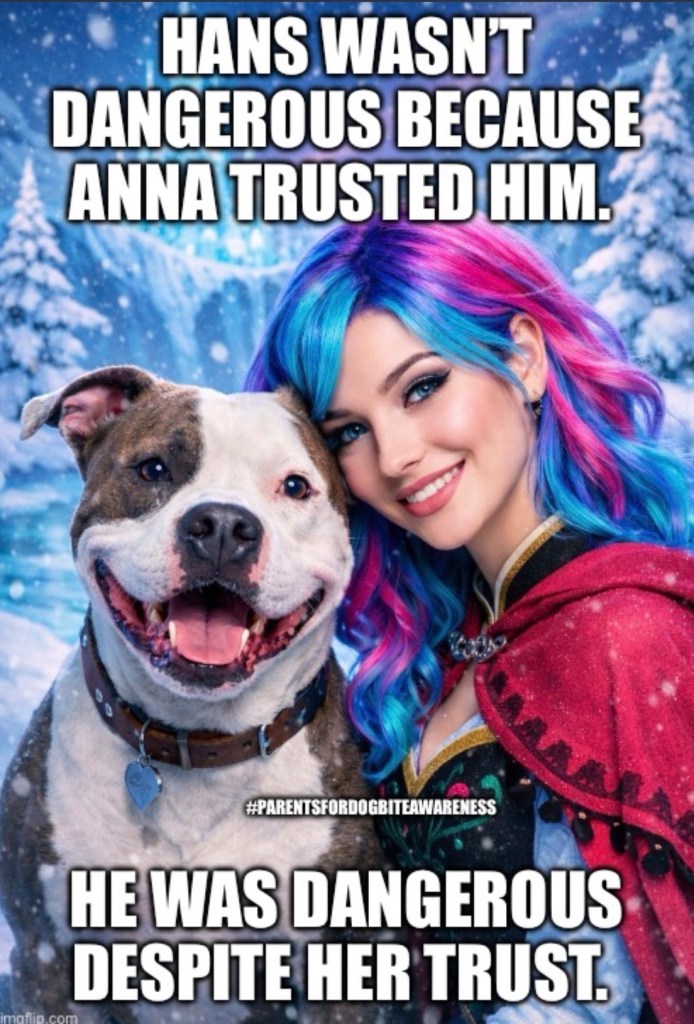
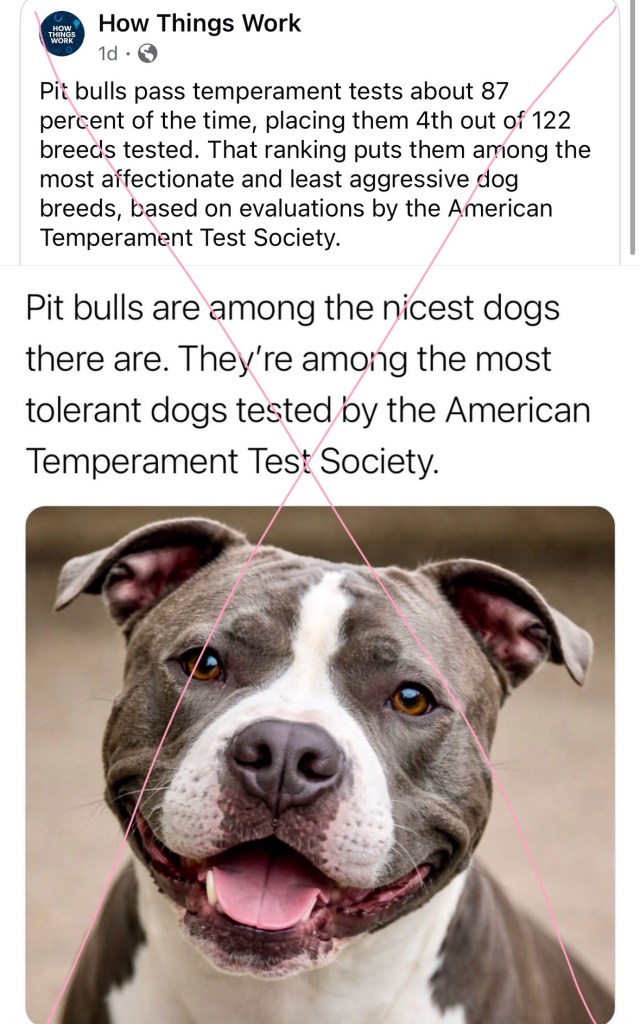
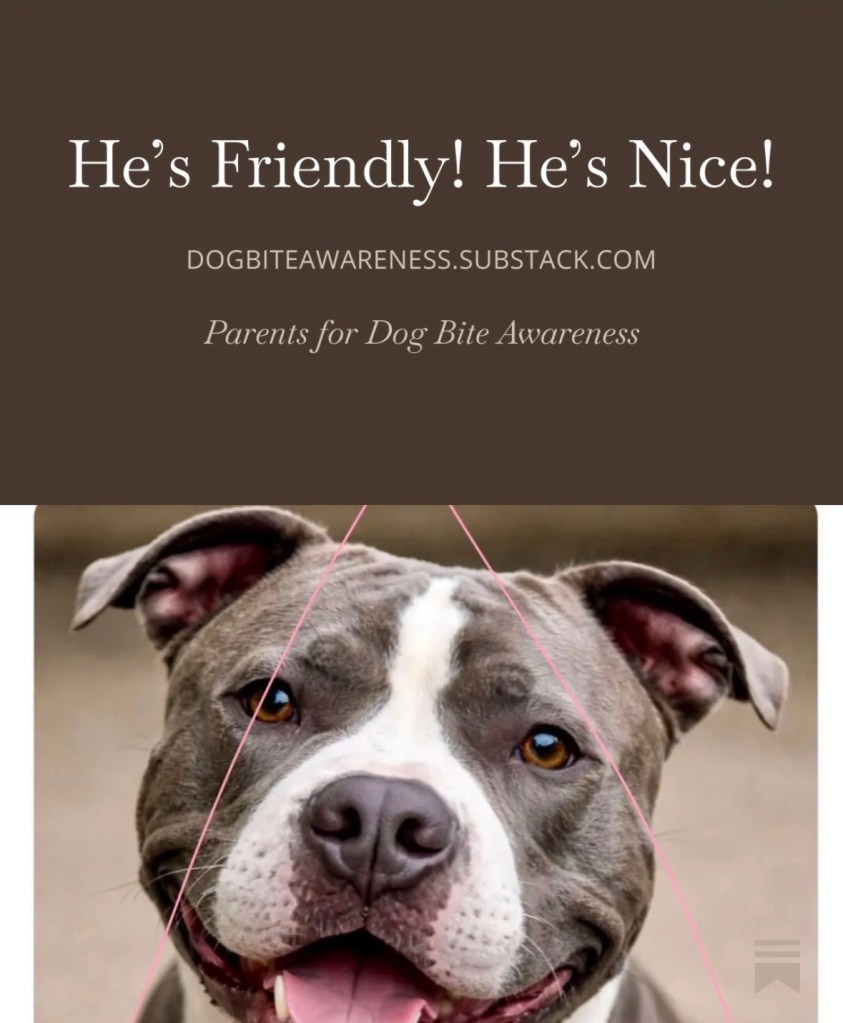
The naïveté is similar to the way Anna relates to Hans in Frozen: with genuine warmth, good faith, and a belief that kindness plus connection equals safety. That belief is understandable but it is also where the danger begins.
Pit bulls are often deeply affiliative. They seek contact, enjoy physical closeness, make strong eye contact, and frequently tolerate handling that would stress other dogs. These traits are interpreted as proof of safety and trustworthiness.
A dog that cuddles, leans in, passes temperament tests, or calmly endures uncomfortable situations feels safe, much like Hans felt safe to Anna.
But charm is not the same thing as safety.
Temperament assessments, shelter evaluations, and “he’s never done this before” narratives measure what a dog does under controlled or limited conditions, not what the dog is capable of under stress, arousal, or misinterpretation. These tools are snapshots, not guarantees. Trusting them can create a false sense of security.
Pit bulls, specifically, were selected for persistence, arousal tolerance, and escalation under stimulation. These are traits that can coexist with friendliness and even sociability. This is the part people struggle to hold at the same time: a dog can be loving and dangerous at the same time. The two are not mutually exclusive. Just as Hans was friendly and perfect for Anna but underneath he had a different agenda.
Like Hans, pit bulls do not signal their risk in ways people expect. There may be no prolonged growling, no obvious fear display, no repeated warnings that fit the textbook model. When an escalation occurs, it is often sudden, intense, and disproportionate to the perceived trigger. This is not cruelty. It is biology interacting with environment and expectation.
The problem arises when humans, like Anna, project moral logic onto an ammoral being:
• “He wouldn’t hurt anyone! I know he loves me!”
• “He passed the test.”
• “He’s gentle with me, so he’s safe.”
Hans didn’t become dangerous because Anna trusted him. He was dangerous despite her trust. In the same way, pit bulls are not made safe by affection, advocacy, or positive experiences alone. Trust does not neutralize capacity. Your feelings for an animal do not change lethality the way Anna’s feelings for Hans did not change his nature.
This doesn’t mean pit bulls are “bad dogs.” It means they are dogs with specific traits that demand honest acknowledgment, not romantic narratives. Love does not replace reality. Assessment does not erase risk.
The emotional shift required is difficult: realizing that your compassion may have led you to downplay risk instead of contextualizing it. Like Anna, many people are not foolish…they are empathetic, optimistic, and operating on incomplete information.
The lesson is not to withdraw care, but to withdraw illusion.
True respect for pit bulls means seeing them clearly. Safety comes from realism, not reassurance. And protecting both people and dogs requires the courage to question charm before it costs someone their face, their child, or the dog’s life.
As we enter 2026 after the most documented human fatalities in the recording history of dog maulings, let’s encourage everyone acting like Anna to let it go. Let go of the propaganda. Let go of the sociopathic charm. Let go of the love bombing and virtue signaling. Let go of the magical thinking.
Narratively, Hans functions as a cautionary example: charm, warmth, and good manners are not indicators of safety, loyalty, or moral character. His arc is deliberately constructed to challenge the “love at first sight” trope and to demonstrate how easily danger can masquerade as kindness.
Let the nanny dog lie go. Let the ATTS lie go. Let’s see if 2026 is the year we begin to stem the tide of maulings.
-JL ©️ #dba
 Parents for Dog Bite Awareness
Leave a comment