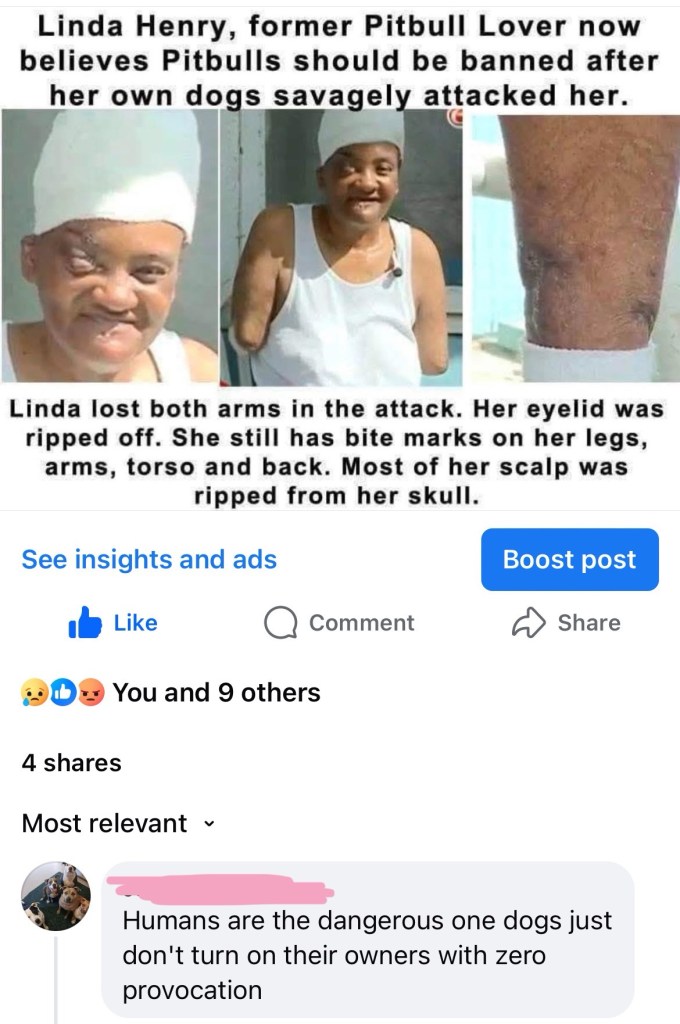
After a tragic awareness post about a woman who lost both her arms in an unprovoked pitbull attack by her own dogs, someone commented:
“Humans are the dangerous one dogs just don’t turn on their owners with zero provocation.”
This brief comment is a striking example of layered psychological defense mechanisms, distorted thinking, and underlying traits seen across various mental health conditions and personality disorders. Here is a clinical level analysis of the dysfunction embedded in this reaction:
🔍 𝟭. 𝗕𝗹𝗮𝗰𝗸 𝗮𝗻𝗱 𝗪𝗵𝗶𝘁𝗲 𝗧𝗵𝗶𝗻𝗸𝗶𝗻𝗴 (Splitting)
Related Disorders: Borderline Personality Disorder (BPD), Narcissistic Personality Disorder (NPD), Paranoid Personality Disorder (PPD)
The commenter frames the issue in binary terms: “humans bad, dogs good.” This defense, called splitting, is a hallmark of immature psychological development and often associated with unstable identity formation.
In personality disorders like BPD or NPD, people struggle to integrate nuance. Dogs are placed in an idealized category, while humans are devalued, allowing the individual to avoid facing moral complexity or personal responsibility in dog ownership.
🔍 𝟮. 𝗗𝗲𝗻𝗶𝗮𝗹 𝗼𝗳 𝗥𝗲𝗮𝗹𝗶𝘁𝘆 (Cognitive Dissonance Avoidance)
Related Disorders: Delusional Disorder, PTSD, Obsessive Compulsive Disorder (OCD)
The comment directly denies the factual nature of the original post, that a person’s own dogs attacked her without any known provocation.
This is an attempt to suppress psychological distress caused by conflicting beliefs (e.g., “dogs are always safe” vs. “a dog maimed its owner”). People with rigid belief systems or trauma linked hyperfixation (often seen in OCD or PTSD) may engage in this dissonance avoidant behavior to maintain a sense of safety or predictability.
🔍 𝟯. 𝗘𝗺𝗼𝘁𝗶𝗼𝗻𝗮𝗹 𝗥𝗲𝗮𝘀𝗼𝗻𝗶𝗻𝗴
Related Disorders: Anxiety Disorders, BPD, Histrionic Personality Disorder (HPD)
Rather than analyze facts, the commenter relies on personal emotion as the basis for truth. The line of reasoning goes: “I love dogs, I feel like dogs are good, therefore dogs can’t be bad.”
This is a hallmark of emotional reasoning, a common distortion in anxious or emotionally unstable individuals. In BPD or HPD, perception becomes heavily colored by moment to moment feelings rather than logic or objectivity.
🔍 𝟰. 𝗣𝗿𝗼𝗷𝗲𝗰𝘁𝗶𝗼𝗻
Related Disorders: Paranoid Personality Disorder (PPD), Narcissistic Traits, Antisocial Traits
By stating “humans are the dangerous ones,” the commenter projects internal fears or aggression onto others.
Projection is a defense mechanism in which a person attributes their own negative impulses or unresolved anger to an external party. In this case, projecting danger onto “humans” helps relieve inner guilt, fear, or mistrust, and may be a coping strategy linked to trauma or paranoia.
🔍 𝟱. 𝗖𝗼𝗻𝗳𝗶𝗿𝗺𝗮𝘁𝗶𝗼𝗻 𝗕𝗶𝗮𝘀
Related Disorders: Schizotypal Personality Disorder (SPD), Narcissistic Personality Disorder (NPD), General Cognitive Rigidity
Confirmation bias is the tendency to seek, interpret, and recall information in a way that confirms existing beliefs.
The commenter ignores a real, tragic example in favor of a comforting narrative: “dogs don’t attack owners unprovoked.” This rigid filter may be intensified in individuals with schizotypal features or narcissistic traits, where the person clings to a curated worldview and rejects contradictory data.
🔍 𝟲. 𝗠𝗮𝗴𝗶𝗰𝗮𝗹 𝗧𝗵𝗶𝗻𝗸𝗶𝗻𝗴
Related Disorders: Schizotypal Personality Disorder, OCD, Childhood Trauma Survivors
The idea that dogs never attack owners unless provoked implies magical or irrational thinking that animals possess moral intent and unwavering loyalty.
This is anthropomorphism fueled by magical thinking, often seen in individuals with unresolved childhood attachment wounds or trauma who assign human characteristics to animals for emotional security.
🔍 𝟳. 𝗩𝗶𝗰𝘁𝗶𝗺 𝗕𝗹𝗮𝗺𝗶𝗻𝗴 (Just World Fallacy)
Related Disorders: PTSD, Personality Disorders with High Control Needs
Saying that dogs only attack with provocation implies that the victim must have deserved it, a form of victim blaming.
This stems from the just world fallacy, a belief that the world is inherently fair and people get what they deserve. This illusion of control protects the speaker from anxiety by creating a false sense of safety (“If I’m a good dog owner, this won’t happen to me”), and it is frequently seen in trauma survivors and controlling personality structures.
🔍 𝟴. 𝗟𝗼𝘄 𝗦𝗰𝗶𝗲𝗻𝘁𝗶𝗳𝗶𝗰 𝗟𝗶𝘁𝗲𝗿𝗮𝗰𝘆 & 𝗜𝗱𝗲𝗼𝗹𝗼𝗴𝗶𝗰𝗮𝗹 𝗙𝗶𝘅𝗮𝘁𝗶𝗼𝗻
Related Disorders: Intellectual Rigidity, Cultic Thinking, Groupthink Dynamics
Finally, the statement demonstrates a fundamental misunderstanding of ethology (animal behavior science). Thousands of peer reviewed studies, veterinary reports, and emergency room data confirm that dogs, especially those with high bite force and low behavioral predictability, can and do attack without provocation.
The unwillingness to examine this data may stem from ideological identification (e.g., “dog people” culture) or compulsive ingroup loyalty, which prevents rational discourse. Such thinking patterns often emerge in cult like dynamics or emotionally enmeshed online communities.
🧠 𝗜𝗻 𝗦𝘂𝗺:
This comment is not just emotionally misguided, it is psychologically revealing. It displays traits seen in multiple disorders and cognitive dysfunctions, including:
• Distorted attachment
• Identity enmeshment with animals
• Magical thinking and projection
• Defensive denial of trauma or risk
• A compulsive need for moral purity in narratives
While not everyone making such comments has a diagnosable disorder, the underlying thinking patterns mirror those studied in clinical psychology and trauma research.
📢 𝗖𝗼𝗻𝘁𝗿𝗼𝘃𝗲𝗿𝘀𝗶𝗮𝗹 𝗳𝗮𝗰𝘁𝘀 𝗱𝗼 𝗻𝗼𝘁 𝗲𝘅𝗰𝘂𝘀𝗲 𝗱𝗲𝗻𝗶𝗮𝗹𝗶𝘀𝗺.
We must be able to confront emotionally difficult truths, especially when public safety and vulnerable individuals are at stake.
#psychology #dogbiteawareness #pitbulls #cognitivedistortions #denialism #mentalhealthawareness #publicsafety


Leave a comment